
Khao Sok National Park is one of Southeast Asia’s most extraordinary wilderness areas. Covering 739 square kilometres on the border of Surat Thani and Phang Nga provinces, it sits roughly two and a half hours by road from Khao Lak — and it is one of the most accessible genuinely wild places in Thailand. For visitors staying on the Andaman coast, a day trip or overnight stay in Khao Sok is the most rewarding inland detour you can make.
What Is Khao Sok National Park?
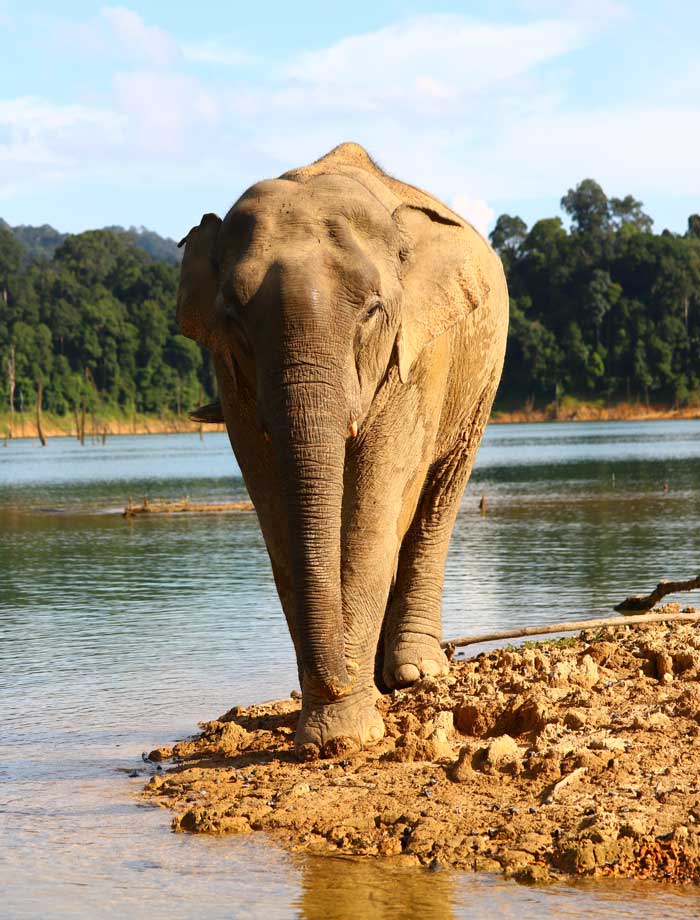
Khao Sok protects one of the largest tracts of old-growth evergreen rainforest in southern Thailand. That continuity translates directly into biodiversity. The park shelters Asian elephants, Malayan tapirs, clouded leopards, gaurs, and several species of bear. Gibbons call from the canopy at dawn. Great hornbills nest in the tall dipterocarp trees. In the limestone cave systems, researchers continue to document species new to science.
The park was formally protected in 1980 and forms part of one of the largest remaining blocks of virgin rainforest in southern Thailand — an evergreen ecosystem believed to be over 160 million years old, predating the Amazon.
Geologically, the park is defined by dramatic karst limestone formations — sheer cliff faces rising from river valleys, worn through by centuries of rainfall into caves, sinkholes, and subterranean streams. The Sok River runs clear and shallow through the park headquarters area, providing easy swimming and kayaking. Further east, the limestone mountains give way to the Ratchaprapha Dam reservoir, which transforms the landscape entirely.
Cheow Lan Lake — The Park’s Crown Jewel
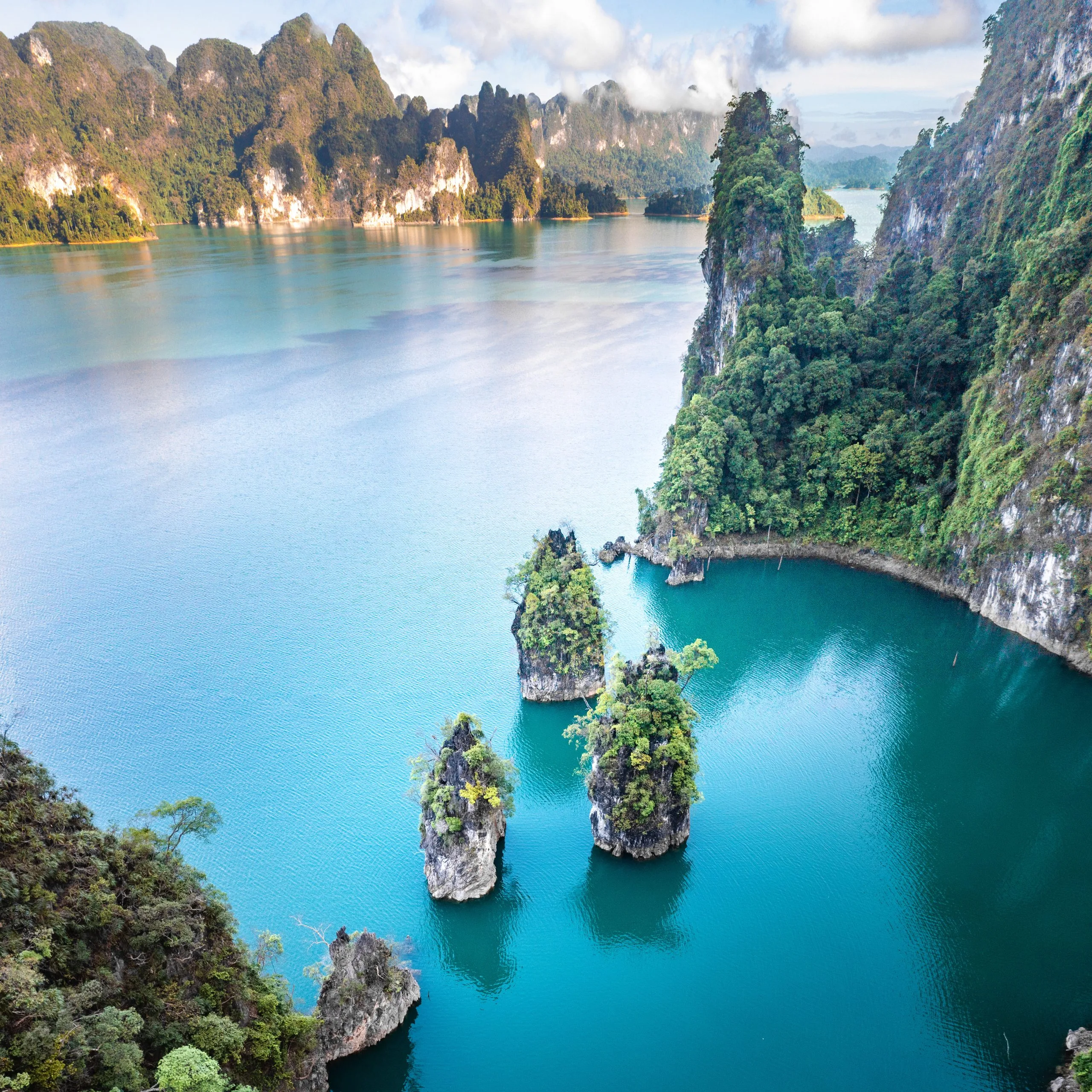
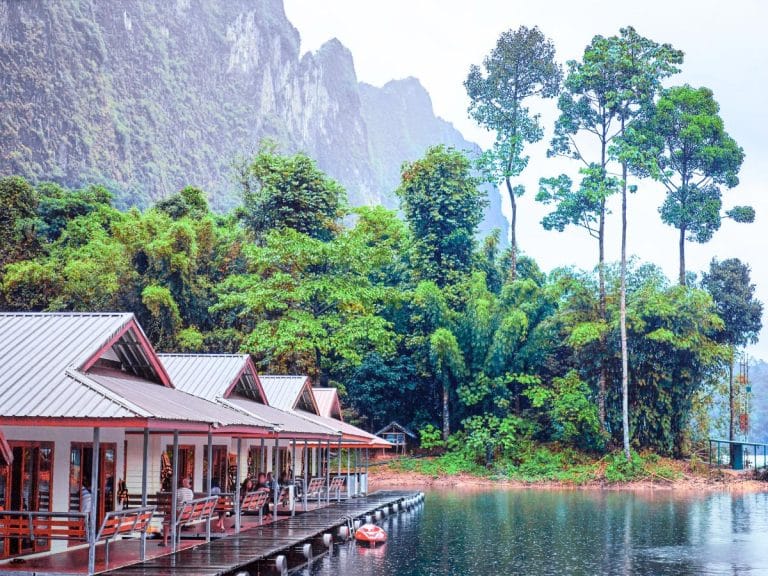
Created in 1982 when the Ratchaprapha Dam was constructed across the Klong Saeng River, Cheow Lan Lake flooded a deep valley and left only the tops of the tallest limestone karsts above the waterline. The result is one of the most visually dramatic landscapes in all of Thailand — sheer grey-green columns of rock rising 300 to 400 metres directly from emerald water, with undisturbed forest running to the ridgeline. The scale is difficult to convey in photographs. Standing on a longtail boat at dawn, with mist still sitting in the valley and hornbills crossing overhead, it is genuinely breathtaking.
The floating bungalows moored on the lake allow you to experience Cheow Lan in a way a day-visit cannot — swimming in the open water at dusk, waking to the sound of gibbons echoing across the karsts, and watching the light change on the cliffs during the golden hour before sunrise. This overnight experience is the single most-requested activity among Khao Lak visitors who have already seen the Similan Islands. If you are planning your time carefully, book our 2-day Cheow Lan Lake floating bungalows tour — it covers the longtail boat journey, Pakarang (Coral) Cave, overnight accommodation, and a guided jungle walk.
What to Do in Khao Sok National Park
The park offers a range of activities across very different terrain. What you can do depends on whether you are visiting for a day or staying overnight.
- Cheow Lan Lake boat tour and overnight floating bungalows — the signature experience. A longtail boat tour of the lake, swimming, canoeing, and an overnight stay in bungalows built on the water. The lake itself covers 165 square kilometres and the boat journey to the bungalows takes around 45 minutes from the pier.
- Jungle trekking — guided walks through the lowland rainforest around the park headquarters follow marked trails through old-growth forest. A guide is strongly recommended; the trails are dense and wildlife encounters are much more frequent with an experienced naturalist. Our Khao Sok jungle trek is built around exactly this terrain, and our family-friendly Khao Sok day trip combines a shorter forest walk with the river and a wildlife hike.
- Night safari — after dark the forest transforms. Slow loris, flying squirrels, civets, and occasionally leopard cats become active. Night walks with a torch-carrying guide are a standard offering and are consistently among the most memorable experiences guests report. Our Khao Sok national park tours combine this after-dark wildlife spotting with an overnight stay on Cheow Lan Lake.
- Rafflesia blooms — between December and February, the park sees blooms of Rafflesia kerrii, the world’s largest individual flower. Spotting one requires local knowledge of where the parasitic plants are currently attached to their host vines; a local guide or ranger can direct you.
- Kayaking the Sok River — the stretch of river near the park headquarters is calm, clear, and lined with forest. Kayaking and tubing are available from several operators near the park entrance.
- Cave exploration — several cave systems in the park are open to guided visits, including Pakarang (Coral) Cave, accessible from the lake by a short jungle walk and bamboo raft crossing.
Day Trip vs Overnight Stay
A day trip from Khao Lak to Khao Sok is a genuine option for the lake — the drive is approximately two and a half hours each way, and a well-organised day tour gives you roughly eight hours in the park, enough to cover the longtail boat journey, Pakarang Cave, swimming, and the return trip. The lake is beautiful under almost any conditions and the day-trip experience is not a compromise.
An overnight stay is a qualitatively different experience. The floating bungalows are quiet after the day-trip boats have left. The lake surface at dusk is still. Gibbons call at first light in a way that day visitors never hear. If your schedule allows even one night, it is worth it. The sunrise over the karsts — seen from the water, from a floating platform, with no other people around — is one of those moments that travel writers reach for superlatives to describe, and for once the superlatives are warranted.
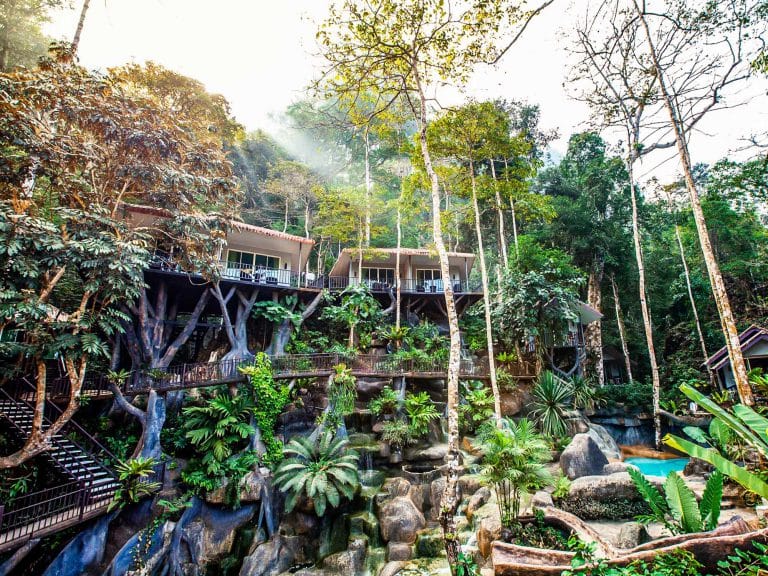
See our Cheow Lan Lake day trip for the full-day option, or our 2-day floating bungalows tour for the overnight experience. We also run a 3-day Khao Sok Discovery Tour that combines a treehouse night, Cheow Lan Lake, and a wildlife safari for guests who want to go deep into the park, or a focused 2-day Khao Sok treehouse stay if you would rather sleep in the canopy than on the lake.
Getting to Khao Sok from Khao Lak
The drive from Khao Lak to the Khao Sok park headquarters is approximately 85 kilometres, taking around two hours on a good day via Highway 401. The road passes through Takua Pa and climbs into the hills — it is a pleasant drive with almost no traffic outside of peak hours. From the park headquarters to the Cheow Lan Lake pier is a further 60 kilometres, extending the total journey to roughly two and a half hours.
Public transport to Khao Sok is possible but slow, involving a songthaew connection that is unreliable for a day trip. The practical approach for Khao Lak visitors is a private guided tour that includes transport, and this is how the large majority of guests visit. All Khao Lak Land Discovery Khao Sok tours include round-trip transfer from your Khao Lak hotel, a local guide, and boat transport on the lake — there is nothing to arrange independently.
Best Time to Visit Khao Sok National Park
The dry season from November through April is the most reliable period for lake tours. Water levels are stable, skies are clearer in the morning, and afternoon storms — when they come — are short. January and February offer the best combination of dry weather and cooler temperatures, and are also the prime months for Rafflesia blooms.
The park is open year-round and the jungle is genuinely more lush during the wet season (May through October). Waterfalls run full, the forest smells extraordinary after rain, and wildlife activity around the river increases. However, afternoon rain is almost guaranteed from June onwards, and the Cheow Lan Lake surface can be rough during heavy weather. Cheow Lan Lake tours are sometimes disrupted in October, which sees the heaviest rainfall. If you are visiting in the green season, the jungle trek and night safari experiences hold up well even in the rain; the lake overnight is the activity most affected by weather.
Practical Tips for Visiting Khao Sok
- Park entrance fee — the national park charges an admission fee per adult. This is collected at the park gate and is separate from any tour cost.
- What to bring — lightweight long-sleeved clothing for jungle walks (protects against insects and sun), a dry bag for cameras and phones on the lake boat, reef-safe sunscreen, and insect repellent. Sandals are fine for the boat; trail shoes for any jungle walking.
- Guides are strongly recommended — the forest is dense and wildlife spotting without a naturalist guide is significantly less rewarding. All Khao Lak Land Discovery tours include a local English-speaking guide.
- Floating bungalow accommodation — the bungalows are simple, clean, and set directly on the lake. Expect beds, mosquito nets, shared bathrooms, and meals cooked to a surprisingly high standard given the remoteness of the location. Electricity is typically available in the evenings from a generator.
- Photography — the light on the karsts is best in the early morning and in the hour before sunset. If you are bringing a camera, a polarising filter makes a significant difference on the lake.
Turn this guide into a trip
Our seven Khao Sok itineraries cover the lake, the jungle and overnight stays, each with pickup from Khao Lak.


0 Comment